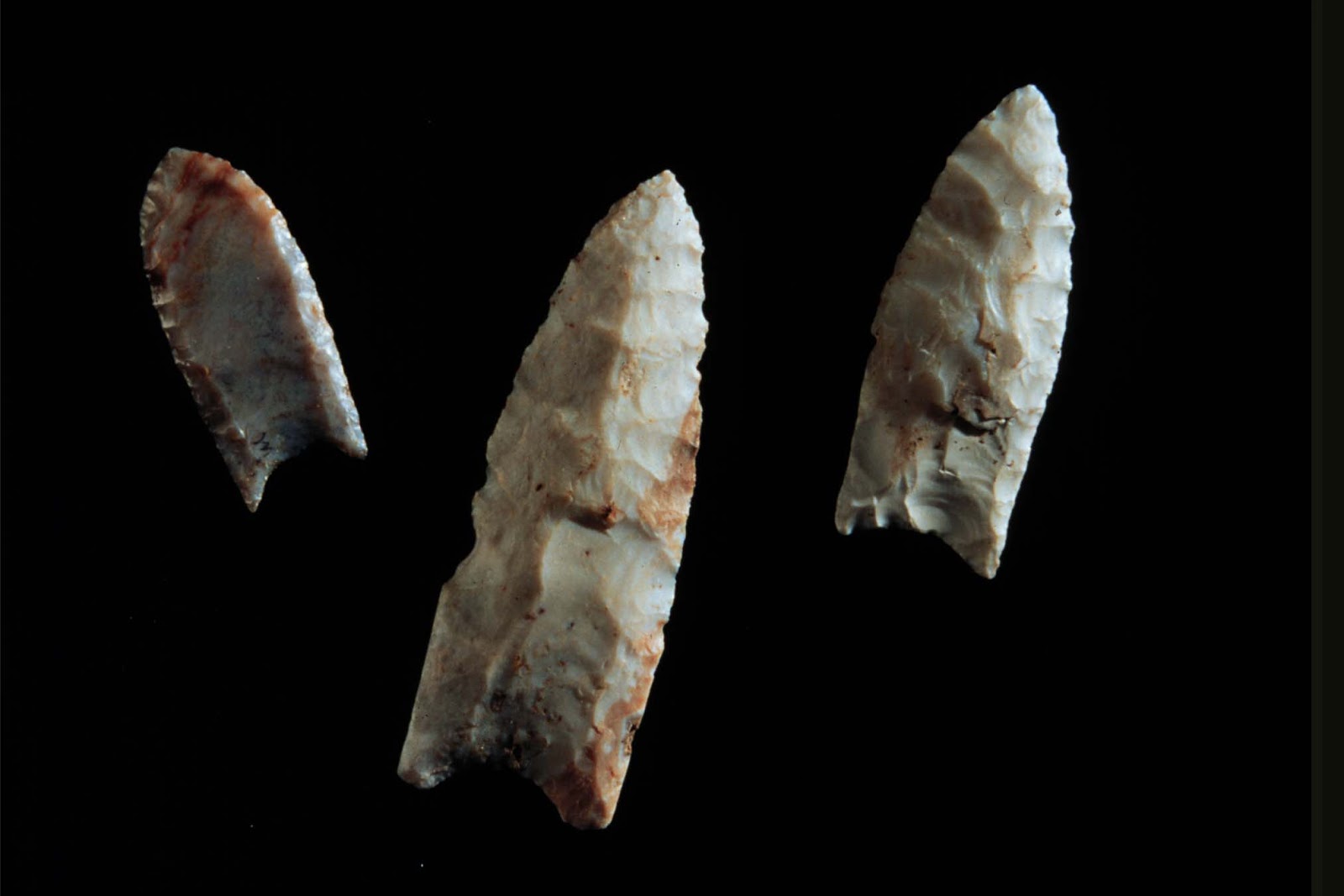
Paleo Indians, in North America, used darts and atlatls to hunt big game such as mammoths and giant ground sloths. Most of us naturally assume this, but archaeologists studying microscopic fractures on Paleo-Age stone points have been able to determine clues for “high velocity, mechanically propelled impacts.” It is largely thought that early inhabitants did not have the bow & arrow, so atlatls were used to hurl long, stone tipped darts for hunting. Also, some evidence of atlatl use come from finding banner stones - weights attached to the atlatl to increase its effectiveness by giving mass and balance to the weapon system. Studying hundreds of Paleo Indian era points, researchers calculated fracture velocities related to spear thrusts, as opposed to a thrown javelin, or atlatl or bow strike. Different velocities create distinct telltale fractures. The study cited atlatl & dart use around 11,000 years ago in North America. In the Old World it was calculated atlatl use began about 20,000 years ago. The value of the research is helpful to show when these technologies emerged and how they traveled across the continent.
Thursday, January 31, 2019
Wednesday, January 30, 2019
Pressure Flaking
In April of 2017 a paper was published from the excavations in Sibudu Cave, in KwaZulu-Natal, a province of South Africa. 25 stone points were unearthed with the telltale signs of an emerging new technology for working stone...pressure flaking. Evidence pointed to the use of a sharpened bone to push against the edge of a stone blank to remove small flakes...sharpening, thinning, and shaping stone points. This technic allowed more control over the finished tool. These artifacts were dated at around 77,000 years old. In Europe, pressure flaking on stone tools was documented about 20,000 - 25,000 years old. There was evidence that a number of these tools had been hafted on a spear or dart from the glue residue. Fourteen of the 25 points had impact fractures and wear indicating they were used for hunting. Because of the excellent conditions of the cave in preserving these artifacts, animal residue, blood and bone fragments, plant fibers and residue were also identified.
Tuesday, January 29, 2019
Maheffy Cache
MAHEFFY CACHE: In 2008 a landscaping crew, on the property of a Boulder, Colorado, resident uncovered a collection of stone tools in a hole the size of a shoe box. Archaeologists confirmed this was a Clovis-Age cache, dated around 13,000 years old, consisting of over 80 stone implements. It consisted of an assortment of platters, bifacial knives, small blades, flakes, and one resembling a double bitted axe. The key to dating the assemblage was protein residues discovered on several of the tools that were used to butcher extinct camels and horses, bear, and sheep. The stone was quarried, and carried in, from sites in Utah, Wyoming, and Colorado. This cache is significant because there have been so few recovered and studied, in such pristine condition.
Fire Piston
Tuesday, January 22, 2019
Backed knives
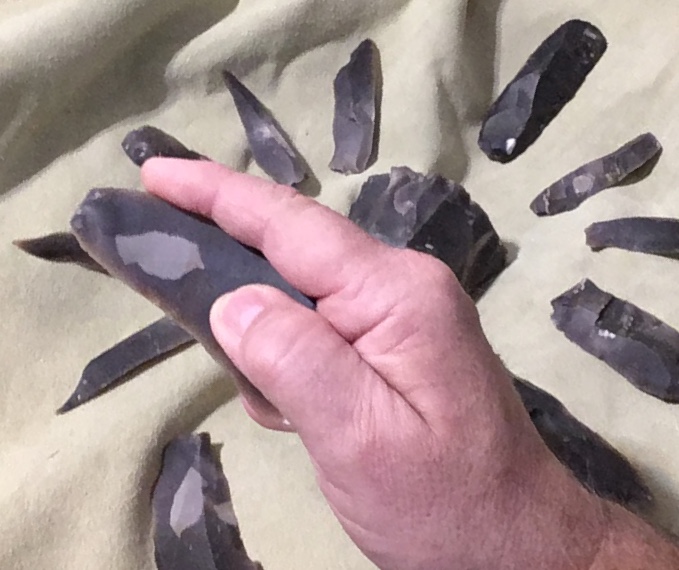
BACKED KNIVES are a distinctive tool form from the Paleolithic. The flakes chosen can be broad and heavy, with cortex still attached on the supporting edge, or thin and long. The distinguishing factors are - one edge is sharp and untouched, with the opposite edge dulled. The dulled edge allows finger support and pressure for cutting activities. It has not been clearly established if this blade was meant to be hafted, or hand held. Backed knives served as cutting edges to use on wood, plant material, or animal products. Pictured also are several Neanderthal backed knives.
Monday, January 21, 2019
Hafting
Dana Kern made a comment on a previous post on the Schoningen spears, a set of six wooden pointed javelins, dating back to over 300,000 years ago, asking why there were no stone tips? The archaeological record shows numerous stone spear points after the 300,000 year mark. In fact, researchers excavating the Kathu Pan site in Southern Africa have found a spearpoint potentially dated to around 500,000 years ago. They ascertain it is a spearpoint by studying the tip fracture to other known spearpoints. Of course, continuing study is going into this. Early man recognized the greater effectiveness of sharp stone spear tips in taking game. But, the whole process of hafting, attaching a point to a shaft, is a complicated subject. Fore thought and planning have to proceed making a spear. The use and ability to control fire is necessary to produce an adhesive filler if used. Making a suitable notch and binding it with plant cordage or animal hide or sinew, is key to producing a sufficiently strong haft, that will hold when facing potentially dangerous or cornered game. Scientists also recognize the importance that language plays to communicate the ideas and methods to make spears and coordinate hunts. Of course, you can’t forget the skill to produce a stone point is paramount. This doesn’t answer why the Schoningen spears did not have stone tips. But, but hopefully we can recognize what a technical achievement the act of fastening a stone to a wooden shaft is.
Technics of Fire Making
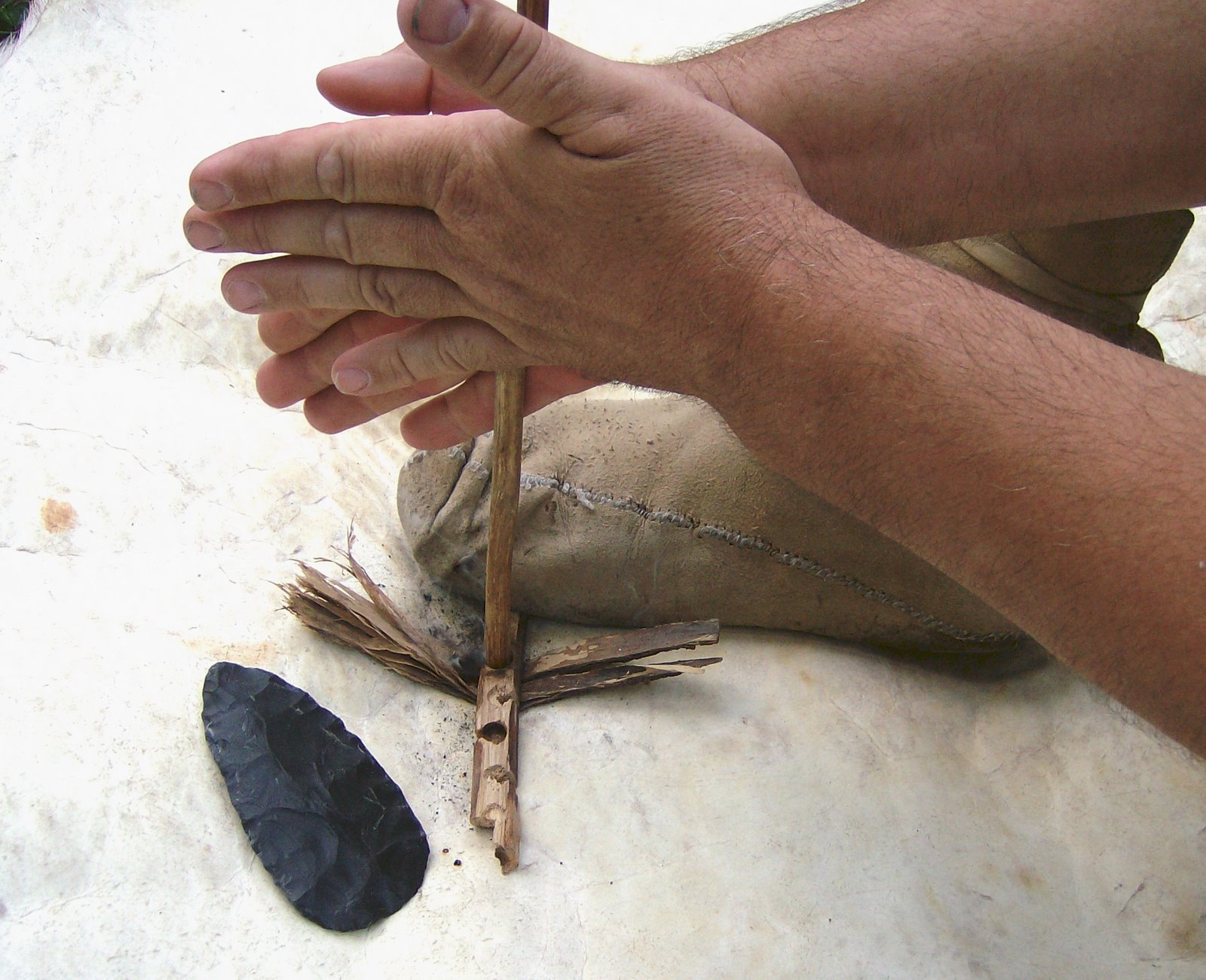
The ability to make primitive fire, breaks down to several major methods: percussion, compression, and friction. Then there are subdivisions of those. Percussion would consist of striking sparks off of pyrites, or some bamboos, with flints. Compression is done with a specially constructed fire piston. Friction has the largest variation of potential technics, between rotating methods and sawing/linear technics. The methods that involve rotating a spindle against a fireboard include hand drills, bow & drill, strap drill, and pump drill. The sawing/linear friction technics consist of the fire plow, fire thong, Rutger roll, and fire saw variations. Pictured is the hand drill friction fire method. A straight slender shaft of appropriate wood is spun between the palm of the hands, against a light/medium density wood fireboard. There is a notch cut into the forming depression. Fibers are ground off the drill and fireboard, that build up in the notch. The heat from the friction generates an ignition temperature around 400 - 800 degrees F., combusting the fibers into a hot smoldering coal. To make fire you need to place the coal into a nest of combustible materials, and spread and increase the temperature, by blowing into it, till it bursts to flame.
Subscribe to:
Posts (Atom)