Friday, January 4, 2013
Recent Tomahawk
This is the latest tomahawk. Made of knapped Texas flint, hafted into a hardwood handle. Deer hide is sewn over the handle and blade lashings. It is decorated with seed beads, horsehair locks, coyote fur, and feathers. Puruse some of the older posts to see pics of prehistoric tomahawks and read some of the history and lore behind the tool.
English Flint Knife
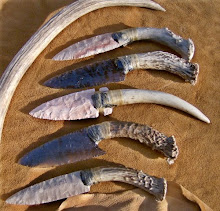
One of my projects this past fall was playing with English flint. My previous experience knapping this material was unimpressive. But, this heat treated blade, percussion knapped, made a nice 6 1/2 inch blade. I hafted this blade into a knobby elk antler and wrapped with it sinew and hide glue to make a 10 1/4 inch stone knife. This type of flint, as the name implies, was used by the prehistoric peoples of modern day England to produce cutting and chopping tools, as well as projectile points. A nice website to check out is www.flintknapping.co.uk. This is the site for John and Val Lord and their prehistoric research projects.
Saturday, May 5, 2012
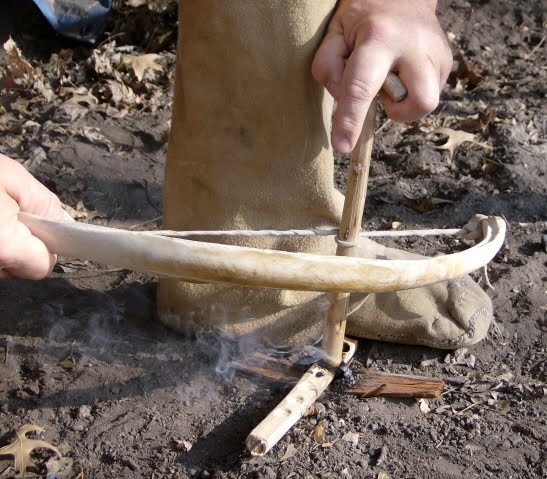
Using Mullein Stems for Bowdrill Firemaking
I love making friction fires...rubbing two sticks together. There is something fascinating about spinning a shaft of wood against another to give life to a glowing ember. Some days I have to spin up a hot coal just to smell the smoldering wood...that's my aroma-therapy.
Earlier this year I started using more mullein stalks as drills for bowdrill firemaking. Mulleins are common in the roadsides and waste areas around eastern Nebraska. They are easily recognized by their velvety rosette of leaves, woody stem, and flowerhead stalk. The woody stalk makes a good drill component when used with a cottonwood fireboard. The stem consists of a sturdy woody outer shell with a styrofoam-like inner pith. The soft inner pith and hard outer stem can be a problem sometimes. A couple of technics help...
One thing I found is that the drill has a tendency to bore through the fire board, thinning or shaving the outer
stem near the business end helps.
Also, cannot sharpen the top of the drill to a point, to spin freely in the socket, because of the soft pithy
core. To aid this, I tied a piece of
cordage around the top of the drill so it would not easily split. Then, sharpening a
short hard wood stem to a point, I force it into the styrofoam like pith. Now I have a hard wooden top to my drill that can take more abuse and be sharpened to spin more freely in the handheld socket.
Wednesday, May 2, 2012
Natakaaru (Pawnee) - Cottonwood Tree
It's been over a year since I've posted...sorry. Life happens. I figure it's time.
I went out to the lakes to clear my thoughts. Some of the female cottonwood trees were already dropping downy seed heads. This normally occurs May to June. To a primitive skills practitioner, I gather the down to add to tinder nests for friction fire making. Alone, the down does not work well, combined it helps to spread the hot coal to the coarser materials. Of course, the dead dry branches work well for the fireboard and drill components of a bowdrill set.
Cottonwood trees are abundant in Nebraska, easily recognized, and useful to the early Native Americans cultures. The papery inner bark works great for tinder nests, twined into cordage, as well as survival food. The Hopi Indians, of Arizona, considered the cottonwood sacred. They used the root to carve Kachina dolls. In spring, before leaves appear, the waxy buds were boiled to make a yellowish dye pigment.
Medicinally, and I wasn't aware of this, a wash of boiled leaf buds or bark was used for burns, cuts, bruises, and skin irritations. The tannin has astringent properties tightening tissue and stopping bleeding.
Pictured top is down bursting from seed pods.
At left are female seed buds.
I went out to the lakes to clear my thoughts. Some of the female cottonwood trees were already dropping downy seed heads. This normally occurs May to June. To a primitive skills practitioner, I gather the down to add to tinder nests for friction fire making. Alone, the down does not work well, combined it helps to spread the hot coal to the coarser materials. Of course, the dead dry branches work well for the fireboard and drill components of a bowdrill set.
Cottonwood trees are abundant in Nebraska, easily recognized, and useful to the early Native Americans cultures. The papery inner bark works great for tinder nests, twined into cordage, as well as survival food. The Hopi Indians, of Arizona, considered the cottonwood sacred. They used the root to carve Kachina dolls. In spring, before leaves appear, the waxy buds were boiled to make a yellowish dye pigment.
Medicinally, and I wasn't aware of this, a wash of boiled leaf buds or bark was used for burns, cuts, bruises, and skin irritations. The tannin has astringent properties tightening tissue and stopping bleeding.
Pictured top is down bursting from seed pods.
At left are female seed buds.
Sunday, May 8, 2011
Always, More Stone Knives
Spring finds me doing some knapping and making knives, processing sinew, and continuing to experiment with the marcasite and flint firemaking. Sometimes I get off work and have to fire up a bow drill hot coal just to smell the aroma of smoldering yucca. I've been anxious to get out and sleep under the stars, but family commitments have kept me busy.Saturday, April 23, 2011
Obsidian & Deer Leg Bone
Monday, April 11, 2011
Marcasite & Flint Fire Making
Decades ago, I remember looking at an old library book, that had a line drawing of a round nodule with a groove in it. It said it was one of the oldest artifacts, from Europe, of a piece of iron pyrite that was used in fire making. Over the years I had tried banging rocks together in an attempt to understand this method. Refining my understanding, I've come to understand that the form of pyrite used is what is called 'marcasite'. There are various forms of iron pyrite with varying crystal formations. The type here has a crystal starburst pattern. I received this piece, in the mail, from Storm in 2008 shortly before he passed away. You can see his work at: www.stoneageskills.com . I came across an article online that kind of put it all together for me, by Susan Labiste, on the Primitive Ways website at: http://primitiveways.com/marcasite%20and%20flint.html . Great researched article and video...check it out. Al Cornell also had an article in the Spring 2008, Bulletin of Primitive Technology, concerning experimenting with various natural spark catchers. The tinder, or spark catcher, is key as the sparks made by scraping the marcasite nodule with a sharp edged flint are very small and almost imperceptible. In truth, every time I wanted to try this technic I had to go into a darkened area so that I could see the sparks and tinder catch. I do not know if I could do this in the light of day very well. Almost all the time when I read about this technic, tinder fungus was used. As I did not have this, I slowly learned that I could substitute other natural materials. Ultimately, I have been having success with cattail or milkweed seed down. I roll this between the palms to condense the fibers into a mat. Also, I have added rotted punk wood finely crushed to the down to help grow and spread the coal once it catches. In the picture is a milkweed pod with smoldering down in it. I kind of stumbled onto the idea of rolling the seed down, and then replacing it in the pod. I strike the sparks onto the down in the pod. When it catches, I have lit a dry piece of punk wood with the smoldering down, and transferred the punk wood into an awaiting tinder nest to be blown into flame. The pod, I simply fold over and smother the coal, leaving me charred down in it own carrying pod for the next fire. This technic has taken years for me to put my mind around, connecting all the dots, ...and thanx in great part to Susan Labiste, Al Cornell, and Storm.
Subscribe to:
Posts (Atom)