
Tuesday, December 15, 2009
Grinding Acorns


Tuesday, December 1, 2009
Making Preforms
Friday, November 27, 2009
Hide for Bow & Drill Socket

Thursday, November 26, 2009

Saturday, November 21, 2009
The Bow & Drill Revisited
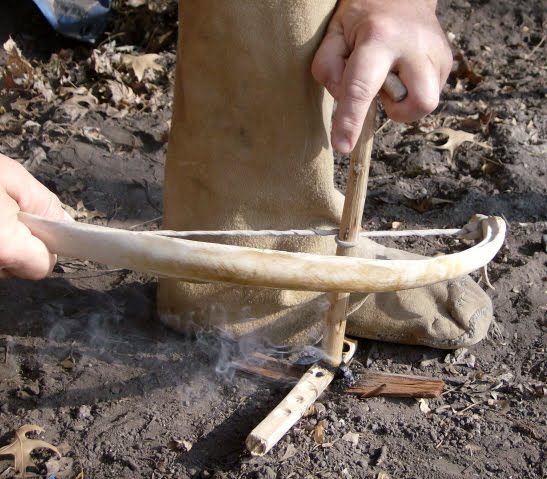 When I first started demonstrating primitive skills at historical events, I tried to tie the technics to local history....what was practiced in this area. My firemaking technic initially was the bow & drill, and later the handdrill method. I could find references to use of the handdrill on the Plains more readily, but the information on the bowdrill was sketchy in North America. It was thought that the bowdrill was an Alaskan Eskimo influence, who had adopted it most likely from Asian migrations across the Bering Straight during Paleo times. It is a fairly sophisticated technic for the time...using a bow and socket to give a mechanical advantage to spin a wooden drill in a depression in the hearth board. The resulting friction grinds off tiny charred wooden particles, which heat up till they combust into a "hot coal". This is placed in a nest of combustable materials and blown into flame. It took a decade to come across solid information placing the bow & drill among Native Americans. Archaeologists have found pieces of a bowdrill set, among the cliff dwellings of the Pueblo Indians of southwestern Colorado, dated to 1400 years ago. And, in an article in the American Anthroplogist from 1935, interviews revealed the technic was used by the Mescalaro Apache who lived in what is now western Texas, southeastern New Mexico, and northern Mexico. It was said it was a technic used by those who had difficulty with the handdrill technic. No special set was constructed for firemaking. Fighting bows were even modified and used to drive the drill. It was related that no special socket was made either, simply a piece of folded rawhide or buckskin was used as a makeshift handhold...(hey, that is a clever idea).
 Friday, November 13, 2009
Side Notched Spearhead

Digging Stick

Subscribe to:
Posts (Atom)


