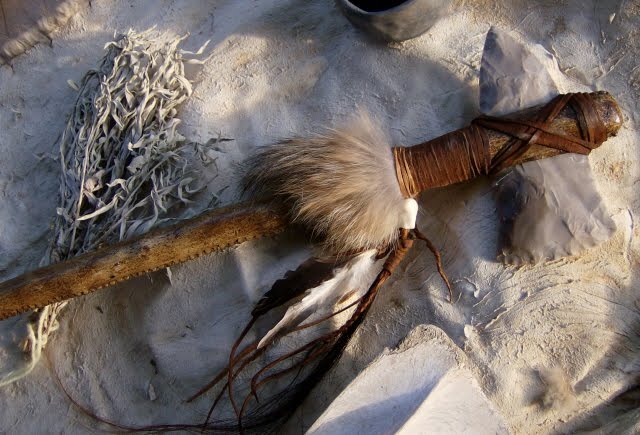
 This is the latest stone knife of two-toned novaculite with an elk antler handle. Slowly, but surely I am dusting off my primitive skills endeavors. Hit the woods last weekend to check it out and do some gathering of odds and ends.
 Sunday, February 27, 2011
Latest Knife
This is the latest stone knife of two-toned novaculite with an elk antler handle. Slowly, but surely I am dusting off my primitive skills endeavors. Hit the woods last weekend to check it out and do some gathering of odds and ends. 

Thursday, January 20, 2011
Corn Cobs & Stalks
 Over the Christmas holiday I stumbled across several you tube videos, by Brandon K. from central Nebraska, that kind of blew me away. He was demonstrating the firesaw technic using cornstalks as the hearth and saw...and doing it in 10-20 seconds! Also, he made a hot coal with the bow drill method using a corn cob as the drill component. Wow, I have cornfields all around me and never have considered this. So, with all the snow/moisture in the area latley I settled for purchasing some bagged corn cobs, you use to feed the squirrels, from the local plant nursery. I cleaned the dried corn from the cob and hastily gathered a used cottonwood fireboard, bow, and socket, and found a piece of dry ground under a shelter. After a couple of attempts fumbling around to get the drill situated to the socket, and tighten the bow cord, I produced a hot coal in 20 - 30 seconds. I have never read of corn stalks or cobs being used historically for firemaking, though it was an indiginous plant to the Americas. If I am correct the Indians taught the Mayflower colonists to grow corn in the New World to survive. Brandon related, as he considered the characteristics of plants that would work for firemaking, that he successfully used the stalks of yucca, mullein, sunflower, corn, bull thistle, hemp, and goldenrod. Hmmm....now I have a few more local plants to try I hadn't considered. Check out Brandon's you tube video at: http://www.youtube.com/watch?v=WZCS-BIFmBQ
Friday, December 10, 2010
Mesolithic Axes
 Around 8500 BC - 4000 BC, in Europe, Mesolithic (middle stone age) man was transitioning from a nomadic hunter gatherer to farming and domestication of animals. They excelled at fishing, learning to build fish weirs for efficiency. Axes were used to fell trees to construct living quarters and fishing vessels, as the above picture depicts from the Archeon, the living history/experimental archaeology park in the Netherlands. Reading a couple of articles concerning artifacts of recovered Danish axes, I became intrigued in their design and use. The two variations below are an antler axe, and a stone blade set in antler. A hole was bored that a slender handle could be run thru and wedged into for hafting. I was a little sceptical how the antler axe would fare chopping wood, but it did as well as the stone axe, on green wood. When it dulled, I just worked the end on across a sandstone abrader. Examples of antler axes have survived because of the properties of the bogs to preserve them. I liked the design of the stone hafted in antler. It is a little light weight but did the job felling shelter poles. It is amazing the ingenuity and variation man developed utilizing natures resources to live and survive.
Friday, April 16, 2010
Late Paleolithic in Nebraska
 What we know about past peoples and events archaeologists speculate from what evidence survived in context with the world in which it was found. They sumise that the Americas were the last of the major continents to be inhabited, starting somewhere around 10000 - 11500 BC. These time frames are changing as new evidence is found. The Paleolithic, or Stone Age, was divided into two eras in North America...the Early and Late Paleo. The Early was marked by the advent of the big game hunters of the Ice Age, using their distinctive Clovis style points to hunt mammoth and mastodon, giant ground sloths, and giant bison. Around 9000 BC the climate began to change in Nebraska as the glaciers receded, becoming much as it is today. The large boreal forests were replaced by grasslands. The large game disappeared and animals similar to today remained. New stone spear point styles emerged with this change. The points were long, narrow, unfluted compared to Clovis styles, and more lance-like...lanceolate. There were a number of varieties which archaelogists recognized as different distinct cultural groups - Agate Basin, Hell Gap, Scottsbluff, Eden, Alberta, Cody, and Frederick. They were still nomadic hunters living off the game and wild fruits and vegetables gathered, and they still had no permanent settlements or farming which marked the next phase of development. The lanceolate points pictured were found in Nebraska and classified, from top to bottom, Eden, Agate Basin, Plainview, and Scottsbluff.


Monday, April 12, 2010
Tomahawk II
The tomahawk is a much romaticized weapon of the Native Americans. Certainly it would have been utilized as a fighting weapon, but much more common and of much more use was as a chopping tool for day to day camp use. The earliest blades were made of stone, sometimes very crudely but with a serviceable edge, and was later replaced by metal axe heads traders bartered with for furs. I knapped several blades out in January and have been waiting for the inspiration to haft them.
Sunday, March 7, 2010
 No deep thoughts or quizzical ramblings lately...just flaking rocks and hafting them to handles. I was watching television Saturday and caught part of a show- a woman in search of "volcanic treasures." On the border between California and Oregon she was searching for rainbow obsidian. A local Native American proceeded to teach her about how it was used by their ancestors for thousands of years to make tools. She broke most of her attempts but managed to come up with a serviceable chipped flake, which her instructor then hafted to a hollowed out deer antler with a mixture of pitch and charcoal. Later in the show he caught a large trout which they prepared for cooking with the obsidian knife. Made this knife, hafted it, watched an interesting show...all in all, a good afternoon.
Friday, February 26, 2010

Subscribe to:
Posts (Atom)


